
Chalkboards to Chatbots
By: Khanh Hoang
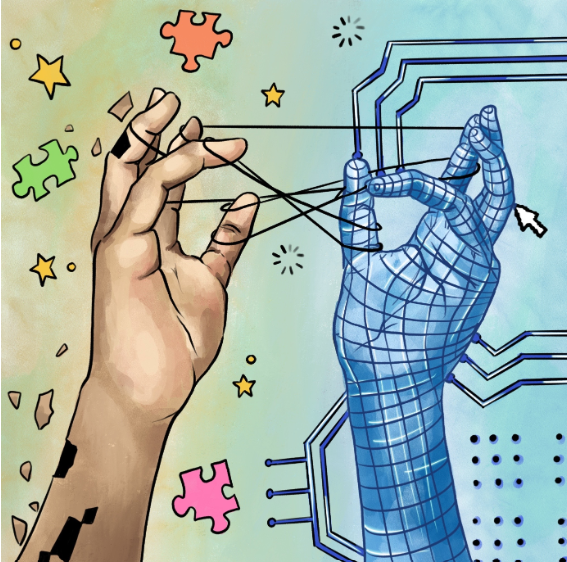
Illustration by Sravya Gullapalli
“As artificial intelligence (AI) becomes increasingly integrated into research, teaching, learning, and daily operations, it is essential that these technologies are used responsibly and thoughtfully.” This statement, published on the University of Texas at Austin’s Enterprise Technology page, reflects the university’s policy on AI: cautious, proactive, while being deliberately broad. It acknowledges both the inevitability of artificial intelligence in higher education and the responsibility institutions have to guide its use ethically. Yet, while university-wide guidance offers an important foundation for usage, it does not fully capture how artificial intelligence is actually experienced inside College of Natural Sciences (CNS) classrooms. In lecture halls holding hundreds of students, where problem solving, conceptual struggle and independent reasoning are essential to learning, the rise of AI tools presents a far more complex reality. Professors–as well as students–are not only navigating new technology, but also redefining what learning, academic integrity, and intellectual growth look like for future generations in an era of instantaneous answers.
For faculty like Dr. Jay Whitehead, a professor in the UT Math Department who assists with the supervision of Supplemental Instruction for the mathematics portion and develops course content for the Sanger Learning Center, AI represents both a collaborator and a challenge. While these tools can support instruction, generate practice problems, and streamline course preparation, they also raise pressing questions: Are students still grappling with difficult concepts, or eliminating that struggle entirely? At what point does AI shift from a learning aid to a cognitive crutch?
Whitehead captures this tension succinctly, warning that AI risks “almost remov[ing] [the] ability to grapple with problems” altogether. His concern expresses a broader unease among CNS faculty. It is not necessarily troubling that students might be using AI to learn, but rather that they might be using it to think. In disciplines–like many represented by the fields in CNS–where growth oftentimes depends on confusion, persistence, and working through failures, bypassing the struggle can undermine the very skills higher education is meant to cultivate.
The temptation to rely on AI can be especially strong for students who are still learning how to learn at the university level. “It’s extremely difficult, I think, for somebody in their first year, especially to know why would I not use AI? So massive challenge for them,” Whitehead includes. The uncertainty does not stop with students. For professors, the widespread availability of AI has introduced new concerns about trust, academic honesty, and the authenticity of submitted work, particularly in large CNS courses. The concern, however, does not mean that professors are uniformly opposed to artificial intelligence. Many educators acknowledge that, when used intentionally, AI can serve as a practical tool rather than a complete substitution for teaching. Whitehead notes that professionals, including educators, can often use AI effectively to support their work, describing how he might ask AI to generate additional practice materials. “AI, give me two or three more example problems that I can put on an exam review for my students,” he explained, emphasizing that in these cases, the technology supports teaching without replacing the learning experience itself.
From the student perspective, artificial intelligence can feel less like a teaching aid and more like a “flashing button” for immediate solutions to academic pressure. CNS coursework is often fast-paced and demanding, and AI tools offer quick explanations, worked solutions and polished responses with minimal effort involved from the user. However, this convenience can come at a cost. Overreliance on AI risks replacing the productive struggle that underlies meaningful learning, particularly in challenging disciplines. As Whitehead observed, “It’s very easy for people to come to [the] conclusion, why am I struggling if I could easily not?” When students bypass the difficulty altogether, they may complete assignments more efficiently but retain less of the material in the long term.
For students who find themselves uncertain when AI crosses from support into substitution, Whitehead emphasized that intention and timing matter. Rather than discouraging AI outright, he encourages students to first “engage with the homework, get to a point where you get stuck on a problem and stay as long as you can, before you resort to AI to help you out,” Whitehead said, “that’s doing yourself the best service.” With this framing, AI becomes a secondary aid rather than a primary solution, a way to clarify misunderstandings after genuine effort has been made.
As these challenges can extend beyond the individual lecture halls, the university has developed several university-wide resources to help students and educators navigate artificial intelligence responsibly. Through its “Responsible Adoption of AI in Teaching and Learning initiative”, stakeholders from across campus have collaborated to create clearer guidance for ethical AI use in academic settings. Additional recommendations and resource collections have been provided by the Center for Teaching and Learning, which offers practical strategies for incorporating generative AI without compromising learning outcomes. Beyond the classroom, interdisciplinary efforts such as “Good Systems” examine the broader social impacts of emerging technologies, while the University’s Student Standards of Conduct are fully accessible to continue to outline expectations for academic integrity.
As artificial intelligence continues to shape higher education, its role in CNS classrooms remains a careful balancing act. While AI has the potential to support learning and expand access to resources, meaningful education is still dependent on effort, reflection, and independent thinking. When used thoughtfully and with intention, AI can enhance the learning experience. However, without clear boundaries, it risks diminishing the very skills universities aim to cultivate. As artificial intelligence continues to evolve in our classrooms, its greatest impact will depend not on its capabilities, but on the intentions of us students who use it.