
Care Counselors Care
CARE Counselors Care
By Khanh Hoang & Kayla Hoang
With the heavy demands and fast paced nature of college life, it’s completely normal to feel like you could use some extra support. Yet, so many of us hesitate to reach out simply because we don't know where to start or feel intimidated by the process of asking for help. A common reason students might not seek help is because they are often unaware of what resources are available to them.
The Counseling and Mental Health Center (CMHC) of healthyhorns at UT Austin offers free, accessible support right in your academic backyard through the CARE (Counselors in Academic Residence) program. CARE places licensed mental health professionals directly within specific colleges and schools across campus, making support far more approachable and applicable. These counselors, in their respective academic colleges, understand the unique concerns of students in the community they serve. For students in the College of Natural Sciences, counselors are equipped to provide support for concerns that are especially common, whether you are stressed about the MCAT (or other graduate entry exams), struggling to balance lab commitments, or navigating the pressure of planning for a career in the sciences.
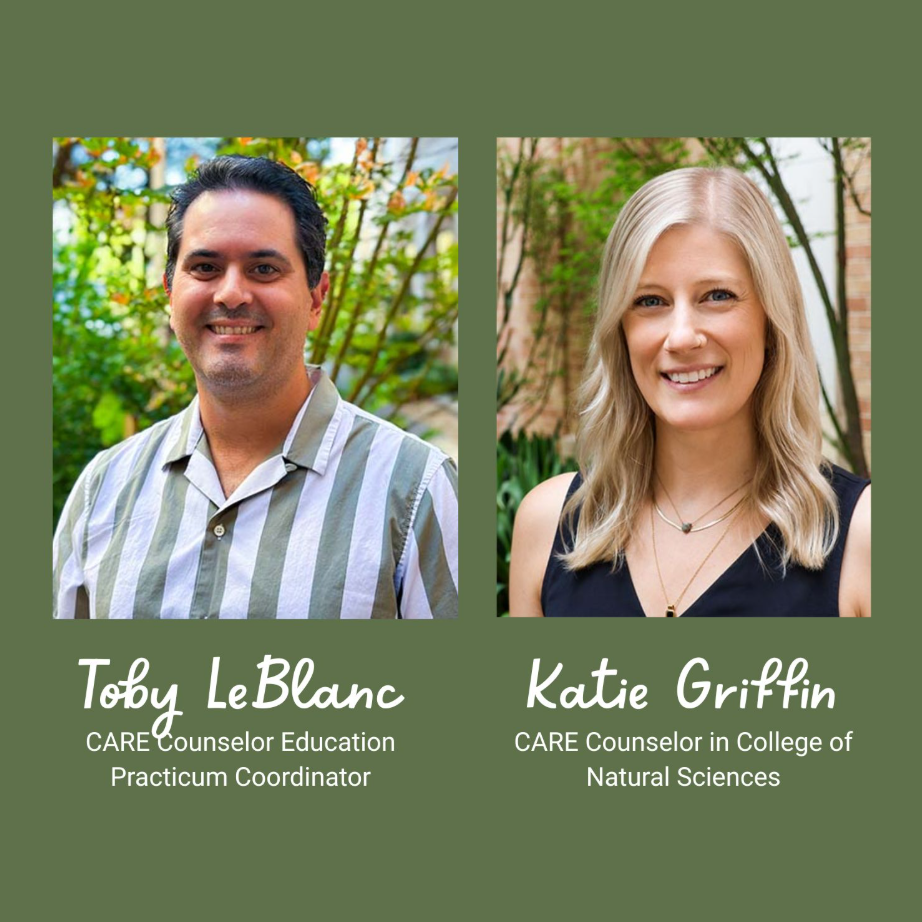
We interviewed two CARE Counselors, Toby LeBlanc and Katie Griffin, to debunk some myths about accessing mental health support through this program. If you've ever thought about reaching out but felt stuck, here is a guide to how accessing CARE works, straight from the counselors themselves!
"I think I want to talk to someone, but I don't even know how to set this up..." What are the different ways students can get in contact with a CARE counselor?
Getting started is much easier than it might seem! There are three primary ways to do so:
Triage Call: You can call the main CMHC counseling line to do a brief triage assessment. You’ll share a bit about what you’re experiencing and your background so the team can pair you with the best service for your needs.
MyUHS Portal: You can coordinate appointments, view schedules, and reach out directly through your online University Health Services portal.
Digital Access: Scan the CARE QR codes posted around your academic buildings, or connect through a quick referral from a faculty or staff member in your department.
"I've never been to therapy before... What if it's weird or uncomfortable?" What would you say to a student who is nervous or unsure about reaching out for the first time?
Taking that first step can feel scary, but you maintain full control over your experience from day one. There is no pressure to share more than you’re ready to; you set the pace, choose what you feel comfortable disclosing, and skip any topic you’d rather not dive into.
"If you want to just kind of see what it’s like to talk to a therapist—because I know a lot of times we are students’ first experience with therapy—you can just drop by an office hour and just have a chat. It doesn’t even necessarily have to be clinical information in nature. We can just start a chat, and if it’s seeming like it’s moving in a direction that’s like therapy, we can start to have conversations about 'do you want to go ahead and engage there?'... We’re really focused on what is the most helpful to you."
— Toby LeBlanc, CARE Counselor
"You have autonomy here to talk about what you want to talk about, and if I ask you a question that you don’t want to get into, just let me know. You’re in the driver’s seat of the conversation."
— Katie Griffin, CARE Counselor
"Why would I go to a CARE counselor instead of just walking into the main health center?" How does the CARE program make counseling more accessible within your academic community?
CARE was built around the idea of meeting students where they already spend their time. Rather than making you walk across campus to a clinical building, CARE counselors are embedded directly inside specific colleges. For example, Toby's office is situated near McCombs School of Business students, while Katie’s office is in Painter Hall, closely connected to College of Natural Sciences (CNS) and pre-health students. Because they work within your specific academic home, CARE counselors fully understand the unique pressures of your major, whether that’s competitive grading curves, intense workloads, or the stress of applying to medical or graduate schools.
"Is my problem even 'bad enough' for counseling? I feel like others need it more..." What are some common misconceptions students have about counseling?
One of the biggest myths is that therapy is reserved only for severe mental health crises. In reality, counseling is just as much about managing everyday stress, burnout, or life transitions before things reach a breaking point.
"My issues aren't serious enough": CARE services are designed for the entire spectrum of student experiences. You don't need to be at a breaking point to deserve space to talk.
"I don't have time for this": In a university full of high achievers, it’s easy to feel like taking an hour for therapy will set you back. But students consistently find that taking that single hour gives them back energy, focus, and clarity that enhances the rest of their week.
Seeking support isn't a sign of weakness; it's a practical habit for maintaining your well being, just like eating well or taking a rest day!
"How do I know if it’s time to reach out?" What are the most common reasons students seek help, and what are the signs?
Students reach out for everything from academic imposter syndrome to personal relationships. Whether you are feeling overwhelmed by expectations, adjusting to a big life change, or just feeling off, no concern is too small to talk through. A very common feeling among UT students sounds like: "I was at the top of my class in high school, but now I’m surrounded by people doing just as well, and it’s hard not to compare myself."
Signs it might be time to check in with someone:
Stress or anxiety is starting to affect most of your days
Mental health symptoms are bleeding into multiple areas of your life, making school harder or keeping you from enjoying your free time
Your usual coping tools (talking to friends, family, exercise, journaling) aren't giving you the relief they normally do. Counseling is simply another tool to add to your toolbox!
"What if I need help right now, outside of scheduled hours?" What other resources exist when you need support fast?
CARE counselors are part of a wider safety net available across UT Austin:
"In our toolbox, we have a lot of tools. So counseling sessions are absolutely something that students have access to, but if students are ever in distress, they can always call the CMHC Crisis Line available 24/7. We also have same-day appointments Monday through Friday, 8 AM–5 PM, for students in distress. Additionally, TimelyCare provides virtual support accessible outside of standard 8-to-5 center hours."
— Toby LeBlanc, CARE Counselor
Start the conversation today! Taking care of your mental health is a journey, and you never have to navigate it alone. Beyond CARE, UT Austin and the surrounding community offer a wide range of support options tailored to you and your concerns:
CMHC Workshops & Groups: Call 512-471-3515 (Option #3)
24/7 CMHC Crisis Line & TimelyCare: Call 512-471-2255 (CALL) anytime, or dial 988 for the national Suicide & Crisis Lifeline.
Online Portal: Access via the MyUHS or CMHC Portal
In-Person Services: Student Services Building (SSB) 5th Floor, 100 W Dean Keeton St.
https://www.healthyhorns.utexas.edu/cmhc/care.html
https://cns.utexas.edu/info-undergraduate-students/supports-services/cns-wellness-center
https://www.healthyhorns.utexas.edu/cmhc/
https://www.healthyhorns.utexas.edu/portal.html
https://www.healthyhorns.utexas.edu/cmhc/timelycare.html