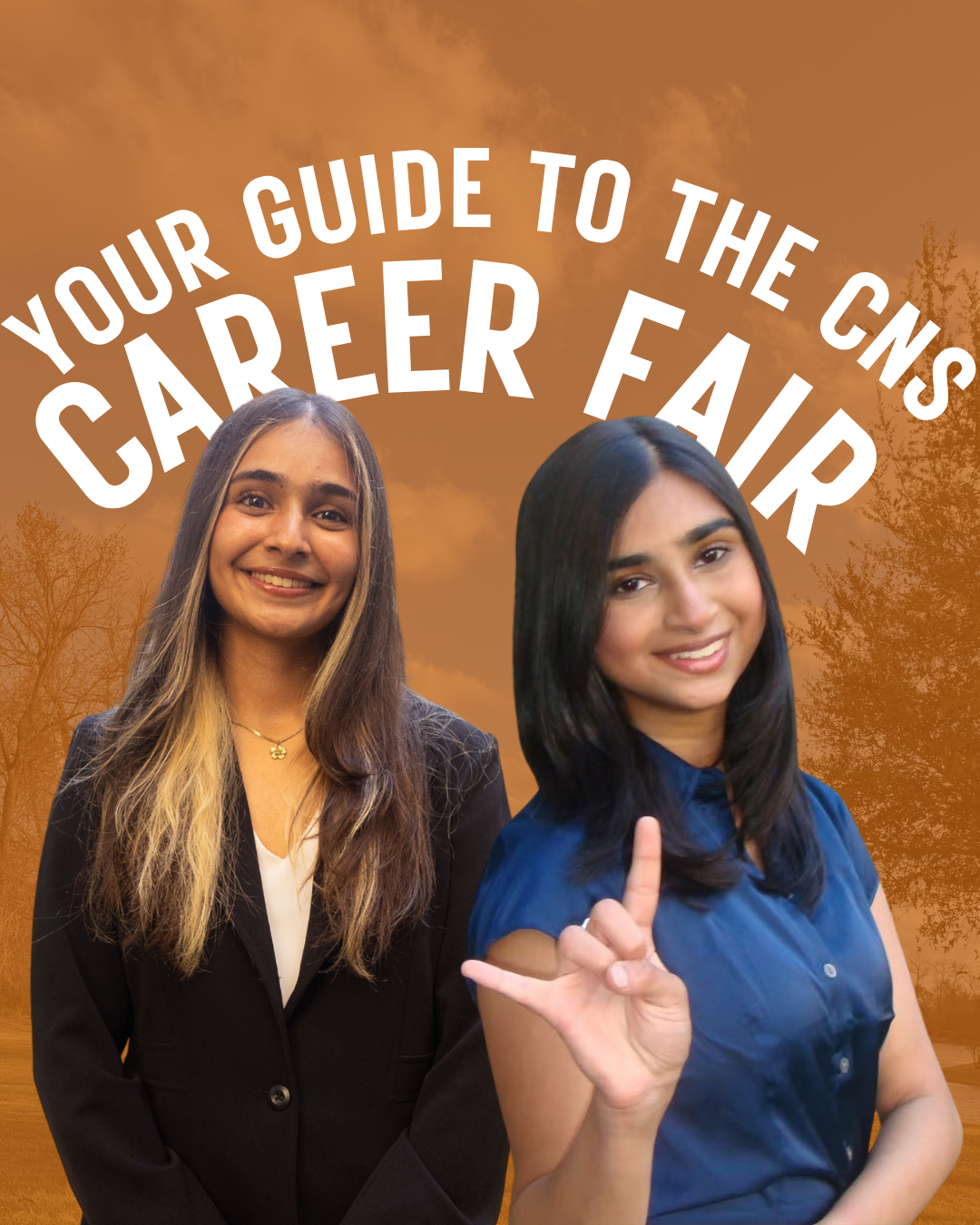
Your Guide to the CNS Career Fair: Two Students on What Actually Matters
By: Shreemayi Undavalli
Interviewees: Somya Krishna and brina patel
The first time Somya Krishna walked into the CNS Career Fair, she wasn’t nervous about small talk. She could talk to anyone. But talking to a recruiter felt different.
“I was always fine with social conversations, but the pressure of conversations felt different at the career fairs,” she says. As a freshman and sophomore, she struggled to find her footing. By junior year, something had shifted. “I felt more comfortable just being myself when it comes to networking.”
Brina Patel had a different first impression. She expected an intimidating room and found the opposite. “I think a lot of people might think that the environment is very intimidating, but I felt the recruiters were there to support you,” she says.
Two students, two very different first experiences, and a lot of lessons in between. With career fair season back on the Forty Acres, here’s what they learned, and how you can walk in ready to succeed!!
Before the Fair: Show Up Prepared
Get help early. Somya didn’t wait until the morning of the fair to figure things out. As a freshman, she booked an appointment with a CNS Career Services advisor and asked friends who had gone before. You can do the same: advisors can review your resume, help you build a plan, and tell you what to expect.
Dress the part. Business casual is the standard, and looking the part helps you feel the part. If your closet isn’t there yet, the UT Outpost Career Closet offers free professional clothing to students, including suit sets, dress shirts, slacks, and shoes. No appointment is needed; just drop by during open hours (listed at the end of this article).
Print more resumes than you think you’ll need. Brina brought 10 copies. That’s a good baseline, since you may end up talking to more tables than you planned. You can print at UT Print stations or University Housing and Dining computer labs for a small fee.
Do your homework on the companies. Most fairs post a list of attending employers ahead of time. Pick three to five you’re most interested in, then look up what they do and what they value. Recruiters remember students who show specific interest.
Practice your pitch. Prepare a 30-second introduction covering who you are, what you’re studying, and what you’re looking for, whether that’s an internship, a full-time role, or research. Say it out loud a couple of times, to a roommate, a mirror, or your pet.
At the Fair: Be a Person, Not a Script
Somya’s biggest breakthrough wasn’t a better resume. It was realizing she didn’t have to follow a script. “I realized that I could simply get to know the recruiters rather than asking only cookie-cutter questions,” she says.
Recruiters are people too, and they’re meeting dozens of students in a day. You don’t have to be perfect. Be curious and be yourself. A few ways to do that:
Ask at least one real question per table: Ask about the team, what a typical day looks like, or what they look for in candidates. A specific question makes you memorable.
Take notes between conversations: By the fifth table, companies start to blur together. Jot down names and details on your phone or in a notebook right after you walk away.
Visit the quieter booths: Don’t skip the smaller or less flashy tables. Some of the best conversations happen where there’s no line.
Get contact info: Grab a business card or connect on LinkedIn with anyone you have a good conversation with.
Brina was surprised by how much the fair offered. “There were opportunities for every major and pre-professional path,” she says.
Set Realistic Expectations
Here’s something Somya wishes she’d known sooner: if you’re a first- or second-year student, don’t measure success by job offers. “Recruiters were looking for upperclassmen,” she says. Those early fairs felt discouraging at the time. Looking back, they were practice. By junior year, recruiters were eager to talk to her, and she was ready.
Brina sees it the same way. “Go with an open mind,” she says, “and even if you don’t get a job or internship from the experience, you still get to learn about career opportunities and make valuable connections.”
After the Fair: Follow Up
The fair doesn’t end when you leave the room. Somya connected on LinkedIn with every recruiter she spoke to and messaged them afterward. Send a short follow-up within 24 to 48 hours: thank them, mention something specific from your conversation, and note any applications you’ve submitted.
Somya also found it worthwhile to look beyond a single event. She attended the McCombs career fair as well, where some employers offered on-the-spot interviews and moved quickly on applications. Casting a wide net across UT’s career fairs gives you more chances to connect.
You’ve Got This!!
A career fair is a conversation, not an interrogation. Prepare ahead, go in curious, and follow up afterward. Whether this is your first fair or your last, every conversation counts. Take a deep breath; you've got this, Longhorn!
Good luck, and see you at the fair!
Resources
UT Outpost Career Closet
The Career Closet, part of UT Outpost, provides free professional clothing for students heading to interviews, career fairs, and other professional events. Learn more: https://studentlife.utexas.edu/sos/ut-outpost.php
Hours:
Tuesday: 2–4 p.m.
Wednesday: 1–3 p.m.
Friday: 1–4 p.m.
Closed Monday, Thursday, Saturday, and Sunday
Resume printing: Computer Labs and UT Print | University Housing and Dining