
The Hidden Hands of the Internet
Written by Ethan trejo
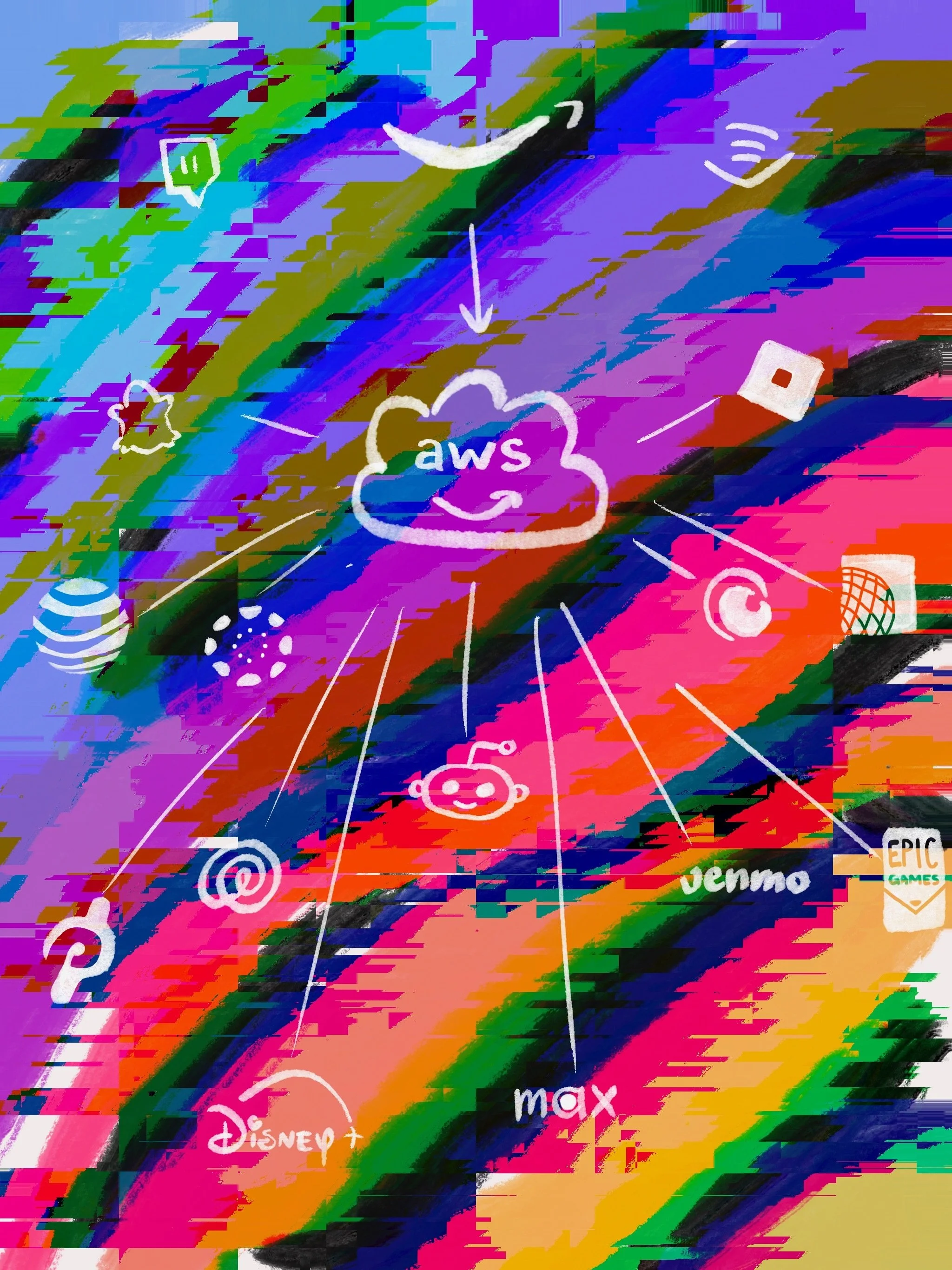
Illustration by Hrishita Das
On the morning of October 20th, 2025, I, like many UT Austin students, was confused when Yik Yak and, more importantly, Canvas wouldn’t load. At first, I thought it was a Wi-Fi issue, but I quickly realized that others were having the same problem. It turned out there had been a major blackout affecting Amazon Web Services (AWS). As someone who is as tech-savvy as a cat walking across a keyboard, I had no idea what AWS was or what it did. All I knew was that I couldn’t study for my genetics test because every resource I needed was trapped behind an unresponsive Canvas. Like many students, I felt helpless as the platform we rely on for homework, grades, and course materials went silent.
While the outage was temporary, it revealed something much larger. Amazon Web Services isn’t just another company; it runs about a third of the world’s cloud computing infrastructure. When one of its data centers fails, millions of websites and apps worldwide can go offline. From streaming platforms and banking apps to government databases and university portals, AWS quietly powers much of the digital world. The company’s dominance is not accidental. What began in 2006 as a tool to help startups host their websites has grown into the backbone of the internet itself.
This isn’t unique to technology. In nearly every major industry, a handful of corporations hold enormous influence over the systems we depend on daily. In banking, for example, just four institutions–JPMorgan Chase, Bank of America, Wells Fargo, and Citigroup–control more than 30% of all U.S. deposits, according to the Federal Reserve. In retail, Amazon and Walmart together account for nearly half of all U.S. e-commerce sales, reshaping how Americans shop and influencing the survival of small businesses. In media, six conglomerates-Comcast, Disney, Paramount Global, Fox, Warner Bros. Discovery, and Netflix-determine what most of the country reads, watches, and streams. Even in healthcare, three insurers-UnitedHealth, Cigna, and CVS Health (Aetna)-cover more than 130 million Americans.
Corporate consolidation has made these industries more efficient and often more affordable, but it has also made them more fragile. When a single company’s systems falter — whether it’s Amazon’s servers or a major bank’s payment network — the effects ripple quickly and widely. The AWS blackout wasn’t an isolated tech failure; it was a glimpse into how deeply concentrated modern infrastructure has become.
Like many, when Canvas finally came back online, I finished my genetics review and moved on. However, I was still shocked to learn how consolidated many of our daily necessities have become. This isn't necessarily a bad thing — efficiency and simplicity make our daily lives much easier. Still, it’s worth remembering that the same systems that make life so seamless can also make it fragile. Understanding how they work helps us appreciate and realize the convenience we often take for granted.