Standing out without Stressing Out!
Standing out without Stressing Out!
CNS Perspectives on Science Internships
Applying to a competitive program can feel like a whole extra class you never signed up for. Between juggling assignments, clubs, and maybe even a job, it is easy to wonder if you have done “enough.” The good news is that strong applications usually come from students who can talk honestly about their experiences, not from students who try to look flawless on paper.
Most successful applicants present a mix of academics, involvement, and personal growth.
Remember that applications are less about proving you are perfect and more about showing that you are thoughtful, reliable, and ready to learn and grow. Below is a guide of common Q&As answered by fellow CNS students.
Tip 1: Setting Clear Goals Before Applying
Students often started by identifying what they wanted out of the experience. They asked themselves questions such as:
What field or topic interests me the most right now
Do I want lab experience, fieldwork, data analysis, or clinical exposure
What skills would I like to build by the end of the summer?
Am I open to leaving Austin for a program?
Having answers to these questions helped students focus on opportunities that matched their goals. Those interested in health-related careers often look for biomedical research or NIH programs. Students interested in the environment tended to choose internships involving field research, remote sensing, or climate data. It's all about what you want to get out of it to supplement your education!
“I really wanted to get more clinical research experience, so I applied to more clinical research than wet lab work, and I think that really helped me see what I wanted to do in the future, because honestly, it was such a different experience.” - Biology Sophomore.
Tip 2: Look and Apply Broadly
CNS students have found opportunities in a wide range of programs. Many of these internships offer hands-on experience, research training, and strong mentorship. A strategy that students consistently recommend is reaching out to past interns on LinkedIn. Those conversations can give you clearer expectations, application advice, and insight you will not find on program websites.
Where CNS Students Found Internships
• NSF Research Experiences for Undergraduates (REU)
• NIH Summer Internship Program
• NASA Earth and environmental science internships
• DOE Science Undergraduate Laboratory Internships
• Oak Ridge National Laboratory
More Internship Ideas by Field:
Biology and Life Sciences
• Molecular and cellular biology REUs
• NIH biomedical internships
• Research labs at UT Austin - Eureka
Chemistry and Materials Science
• DOE Science Undergraduate Laboratory Internships
• Oak Ridge National Laboratory programs
Environmental and Earth Sciences
• NASA climate and Earth science internships
• NSF Environmental Biology REUs
Pre-Med and Biomedical Research
• NIH Summer Internship Program
• CDC Public Health Scholars
Computational and Data Science
• DOE computational research internships
• NOAA modeling internships
A biochemistry junior shared, “I reached out to a past lab intern last January via LinkedIn, and he helped me understand what the work would actually be like. He even looked over my essays for me.”
Tip 3: Spotlight And First-Hand Advice:
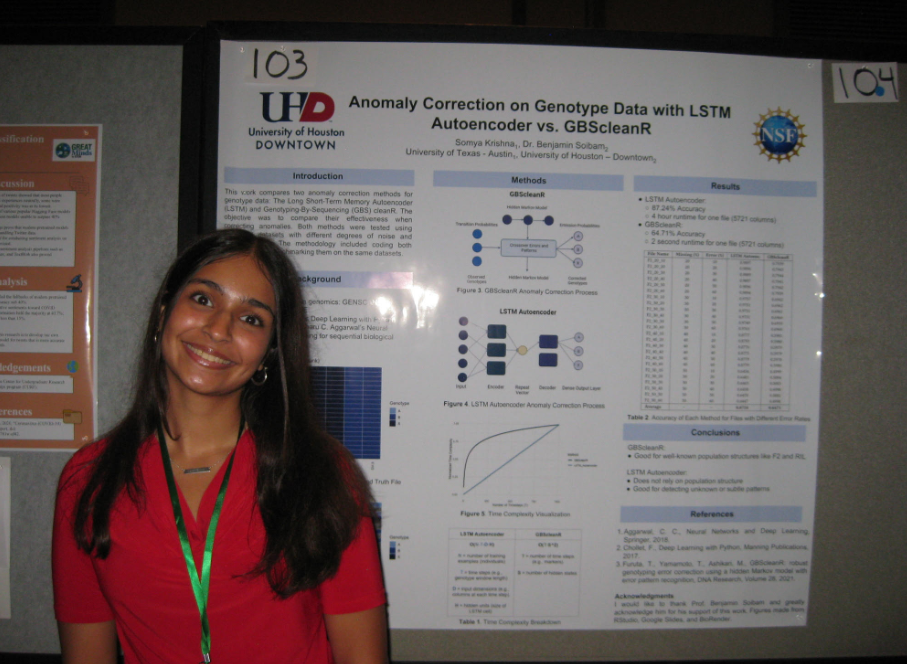
Somya Krishna, SDS Sophomore, pictured at her REU Poster Presentation
Statistics and Data Sciences sophomore Somya Krishna offers an inside look at what undergraduate research can feel like for CNS students. This past summer, she was one of only six students selected for NSF Computational Engineering research at the University of Houston–Downtown, where she worked closely with a faculty mentor on machine learning approaches to genotype data.
“I evaluated the accuracy of each method and found LSTM Autoencoder to have 87.24 percent accuracy and a 4-hour runtime, while GBScleanR was 64.71 percent accurate with a 2-second runtime. I presented my findings at the Great Minds in STEM Conference in San Diego in October 2025, where I learned to compile insights into actionable strategies and communicate them to people who do not work in the same field as me. I learned so much from my professors and peers during this experience. I would recommend any students in technology fields to explore research opportunities like these.”
Somya also shared a bit of application advice for students considering similar programs. She emphasized that clarity and genuine interest matter more than trying to sound overly technical. She suggests highlighting specific topics you are curious about, reaching out to potential mentors early, and showing that you are willing to learn even if you are not an expert yet. For her, demonstrating excitement about the research question was just as important as listing skills.
Overall, she encourages students to take the leap, apply widely, and not underestimate what an undergraduate researcher can contribute.