
Legislation Spotlight: Extending Hours of the Welch Nucleus
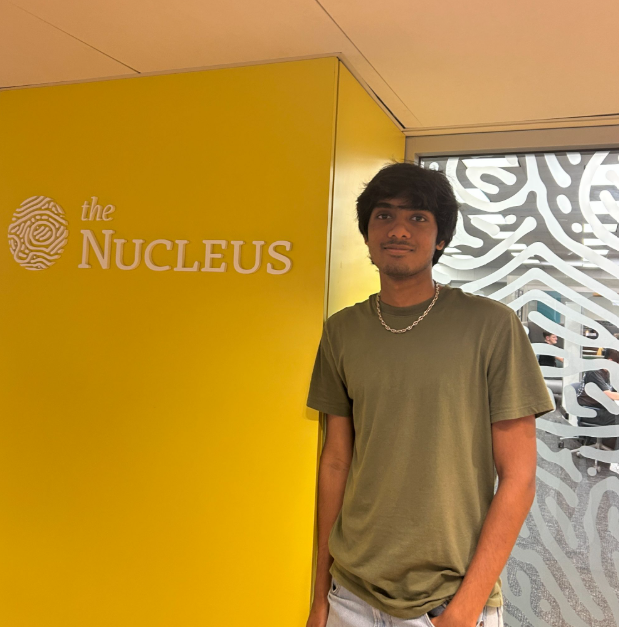
Sai Kolluru, NSC Member
Written by Khanh Hoang
Legislation by Sai Kolluru
Tucked in the back of Robert A. Welch Hall is a beloved gem within the College of Natural Sciences: a study space students have come to know as “The Nucleus.” As one of the most popular gathering spots for CNS students, the space is often filled with organic molecules sprawled across whiteboards, laptops open to problem sets, and half-finished Up and Atom matchas scattered across the tables. Yet as evening approaches, many students find themselves gathering their belongings and heading across campus to the PCL or other areas for late-night studying, as The Nucleus closes as early as 8 p.m. Hoping to change this, Sai Kolluru, a sophomore public health student, has proposed legislation geared towards improving student spaces and accessibility to expand access to study spaces for CNS students.
Currently, several key study areas available to CNS students close their doors relatively early. The Nucleus in Welch Hall operates from 9 a.m. to 8 p.m., while the space that has been the Kuehne Physics, Mathematics and Astronomy Library is being remodeled and will have more study space there soon; it is unclear what the hours will be and whether there will be an extension beyond the previous 6 p.m. weekday closure when the space was a library. The Life Science Library closes even earlier at 6 p.m. For students balancing demanding coursework, research, and long days on campus, these limited hours can make it difficult to find accessible buildings in the evening.
Sai’s inspiration for the initiative came from both personal experience and conversations with other students. While tabling for the Natural Sciences Council through an outreach initiative called Food for Thought, he had the opportunity to speak directly with CNS students about their academic experiences and concerns. Many of the responses pointed to the same issue: students wanted greater accessibility to study spaces, particularly in the evening. Through these conversations, Sai “also found the same issue about study spots, so [he] had a personal motivation.” This ultimately showed him that what began as a personal frustration was in fact a shared experience among many CNS students.
In terms of progress, CNS faculty have already approved extending the hours of The Nucleus to 10 p.m., a significant first step to improving accessibility to these spaces. However, Sai hopes to continue this progress by advocating for hours to eventually extend until midnight. He also plans to collaborate with faculty to explore the possibility of opening the space on weekends, which would provide students with a consistent and reliable study environment during some of the busiest academic periods of the week.
For all students in the College of Natural Sciences, Sai’s legislation and its progress made thus far represent a significant impact as this initiative seeks to create a more supportive academic environment. Expanding hours and increasing accessibility would allow students to remain in familiar, collaborative spaces safely and productively. Sai hopes the initiative will ultimately “make a noticeable improvement for CNS students to find areas to study without having to go through trouble,” allowing students to spend less time searching for open study spots and more time focusing on their academic work. As this initiative continues to progress, Sai’s efforts will hopefully set a future precedent for other CNS study environments to be welcoming and inclusive to reflect students’ needs.